
Does sleeping sober you up?
Sleep does not change how fast alcohol leaves the body. And going without sleep produces impairment of its own — findings measured since 1972.
August 30, 2026 · 3 min read
The short answer: no
Sleep does not change the rate at which alcohol leaves the body.
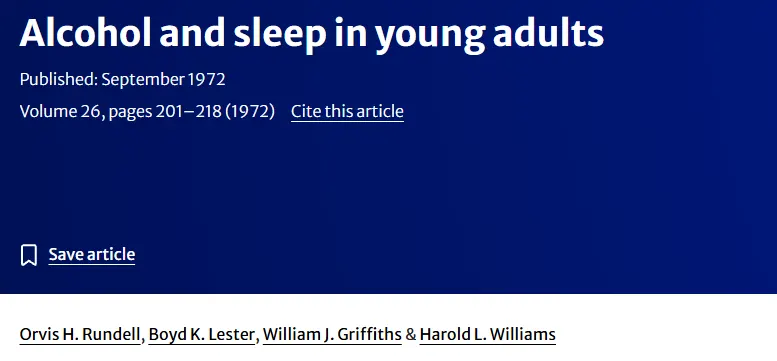
This was measured directly back in 1972. Rundell and colleagues compared the rate of ethanol elimination from the blood in ten people, both while asleep and while awake, and found no meaningful difference between the two conditions. Participants started from a peak of roughly 75 mg/100 mL (0.75‰); after four hours in bed the average had fallen to 30 mg/100 mL (0.30‰). That works out at about 0.11‰ an hour — right inside the range you would expect in someone who stayed awake.
The liver does not sleep
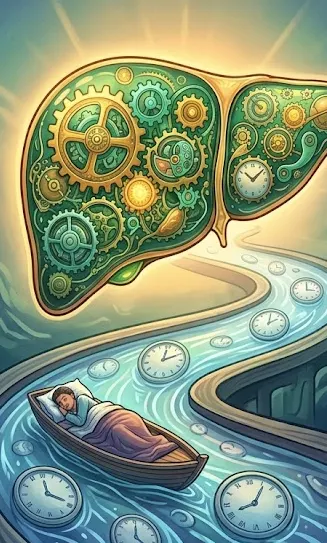
The enzyme works at the same speed whether you are asleep or awake. The only thing that passes is time, and sleep changes only how that time feels, not how much of it there is.
But that is not the real point
That sleep does not speed alcohol up is only half of it. The other half is more interesting: sleep loss on its own produces impairment much like alcohol’s.
Dawson and Reid measured this in a study published in Nature in 1997. They tested cognitive psychomotor performance both under prolonged wakefulness and under rising blood alcohol levels, then matched the two curves against each other. The picture that emerged: 17 hours awake produces a drop in performance equivalent to a blood alcohol level of 0.05%, 22 hours to 0.08%, and 24 hours to 0.10%.
Converting those figures into per mille makes clear what they mean: staying awake for 17 hours produces cognitive impairment equivalent to roughly 0.50‰, and 24 hours awake to roughly 1.00‰.
Seventeen hours is not a long time. Someone who got up at seven in the morning is there by midnight.
In the authors’ own words, their aim was to express fatigue-related impairment as a “blood alcohol equivalent”, giving policymakers and the public a measure that is easy to grasp.
The trap here
This finding is often read backwards: “so alcohol is not that bad after all.” That is not the inference. The correct reading runs the other way — fatigue is a source of impairment far too serious to take lightly. The comparison does not make alcohol lighter; it makes fatigue heavier.
When the two come together
Here is where it really matters. In a study published in 2001, Arnedt and colleagues compared the effect of alcohol with the effect of prolonged wakefulness in a driving simulator. On measures of lane keeping and speed variability, 18.5 and 21 hours awake produced changes of the same magnitude as blood alcohol levels of 0.05% and 0.08% respectively.
The same team’s study a year earlier tested the two in combination and found something more troubling. Twenty hours of wakefulness combined with alcohol lowered participants’ subjective sleepiness ratings — that is, they felt less sleepy. Their performance was deteriorating while their awareness of it was fading.
This is the single most important sentence on the subject. When two sources of impairment stack, what you get is not just more impairment but also less awareness of it.

Sources
- Rundell OH, Lester BK, Griffiths WJ, Williams HL. Alcohol and sleep in young adults. Psychopharmacologia. 1972;26(3):201–218. PMID: 4342143
- Dawson D, Reid K. Fatigue, alcohol and performance impairment. Nature. 1997;388(6639):235. PMID: 9230429
- Arnedt JT, Wilde GJS, Munt PW, MacLean AW. Simulated driving performance following prolonged wakefulness and alcohol consumption: separate and combined contributions to impairment. J Sleep Res. 2000;9(3):233–241. PMID: 11012861
- Arnedt JT, Wilde GJS, Munt PW, MacLean AW. How do prolonged wakefulness and alcohol compare in the decrements they produce on a simulated driving task? Accid Anal Prev. 2001;33(3):337–344. PMID: 11235795
This text and its images were produced with AI and compiled by the site owners.