
What is a promille?
A promille is one part per thousand. How many grams of alcohol 1.00‰ means in the body, how the same value is written in different countries, and why it is a ratio rather than an amount.
August 13, 2026 · 2 min read
What “one part per thousand” means
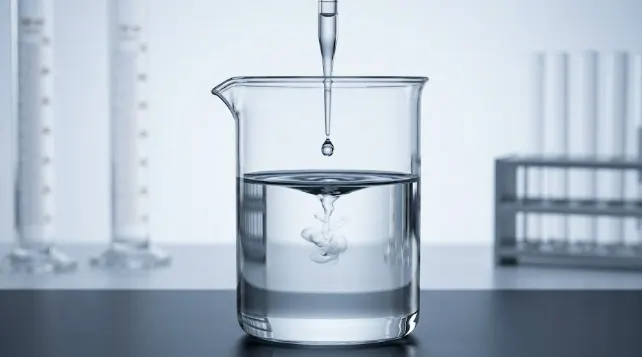
Promille means “one part per thousand”. Where the percent sign (%) divides a whole into a hundred parts, the promille sign (‰) divides it into a thousand. In the context of blood alcohol, that means this: 1 promille is one gram of alcohol in one litre of blood.
The number looks small, but the quantity behind it is not. Alcohol does not spread into fat tissue — it spreads into body water. In an average adult man that distribution volume is roughly 70% of body weight, and in a woman roughly 60% — about 49 litres for a man weighing 70 kilograms. So a reading of 1.00‰ means around 40–50 grams of pure alcohol circulating in that person’s body. By volume, 50–60 millilitres: enough pure ethanol to fill an espresso cup, spread through all of the blood.
The same value is written differently in each country
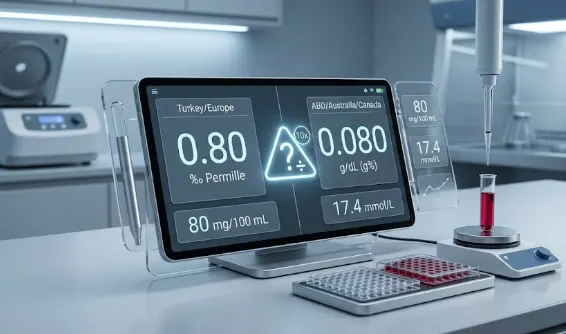
Several units are used around the world to report blood alcohol, and this is the single most common source of error when reading international sources. The same physical fact can be written in all of these ways:
| Unit | Written as | Used in |
|---|---|---|
| ‰ (promille) | 0.80 | Türkiye and most of Europe |
| g/dL (g%) | 0.080 | USA, Australia, Canada |
| mg/100 mL | 80 | United Kingdom, Ireland |
| mmol/L | 17.4 | Some clinical laboratories |
Skipping the conversion causes a tenfold error
The conversions are simple: divide the promille value by 10 for g/dL, multiply by 100 for mg/100 mL, divide by 0.04607 for mmol/L. In practice, though, people forget to divide. Someone who reads “0.08” in a US source and takes it to mean 0.08‰ has just read a value that actually corresponds to 0.80‰ as ten times lower than it is. This mistake happens regularly in clinical practice and in translated news reports.
A promille is a ratio, not an amount
This is the point most often missed. A promille answers the question “how much of your blood is alcohol”, not the question “how much did you drink”. The two are not the same thing.
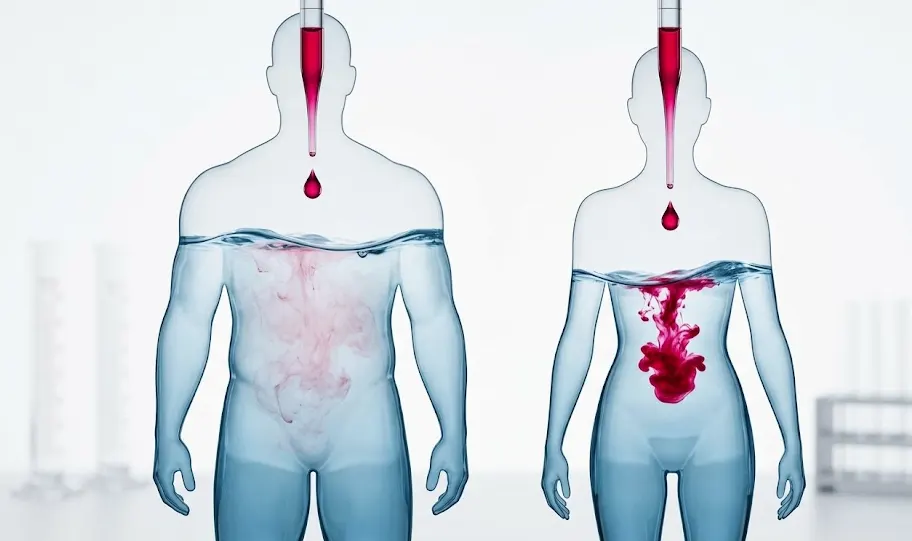
Once alcohol enters the body it barely passes into fat tissue at all; it goes where the water is. The same amount of alcohol therefore spreads through a larger volume in a person with more body water, and produces a lower concentration. That is why the same glass, drunk over the same time, produces two different promille values in two different people — weight, height, sex and body composition all determine that volume.
This is exactly why Promilaj asks for personal details. Without them the only thing that could be calculated is “how many grams of alcohol you drank”; the promille value can only be estimated once you know how much water that alcohol was spread through.
Sources
- Jones AW. Alcohol, its absorption, distribution, metabolism, and excretion in the body and pharmacokinetic calculations. WIREs Forensic Science. 2019;1(5):e1340.
- Jones AW. Concentration units used to report blood- and breath-alcohol concentration for legal purposes differ between countries. J Forensic Sci. 2024.
- Cederbaum AI. Alcohol Metabolism. Clin Liver Dis. 2012;16(4):667–685. PMID: 23101976
This text and the images were generated with AI and compiled by the site owners.